

How to Tailor Resume for Job Applications Without Rewriting It Every Time
Recruiters often decide within seconds whether to keep reading. An applicant tracking system makes an earlier pass by matching titles, skills, and keywords to the job description. A tailored resume improves keyword match rate, sharpens relevance, and usually gives you a better shot at moving from application to interview.
Why a tailored resume performs better
A generic resume forces the recruiter to do the matching work. Most will not. They scan for job title alignment, relevant tools, recent achievements, and proof that your background fits the opening.
ATS filters work the same way, just more literally. They parse section headings, extract skills, and look for overlap between your resume and the posting. If the role asks for “SQL, forecasting, stakeholder management, and Tableau,” but your resume says “data tools” and “cross-functional work,” you may have the experience and still miss the match.
Tailoring also improves your interview-to-application ratio. Even a 5% response rate means 5 interviews from 100 applications. If tailoring lifts that to 10%, the same volume produces 10 interviews. That difference changes your timeline.
What you need before you start
You do not need to rebuild your resume from scratch for every role. You need a repeatable system and five inputs:
- A master resume: full work history, projects, metrics, tools, certifications, and achievements
- The target job description: copied into a working document so you can mark it up
- A shortlist of relevant wins: 8–12 bullets with hard numbers, outcomes, and tools used
- Company and role context: industry, team function, seniority, business model, and likely priorities
- A fit-check method: a way to score resume-to-job alignment before you submit
This is the foundation for anyone searching how to tailor your resume for each job application at scale. One strong master resume saves hours later.
Step 1: Break down the job description
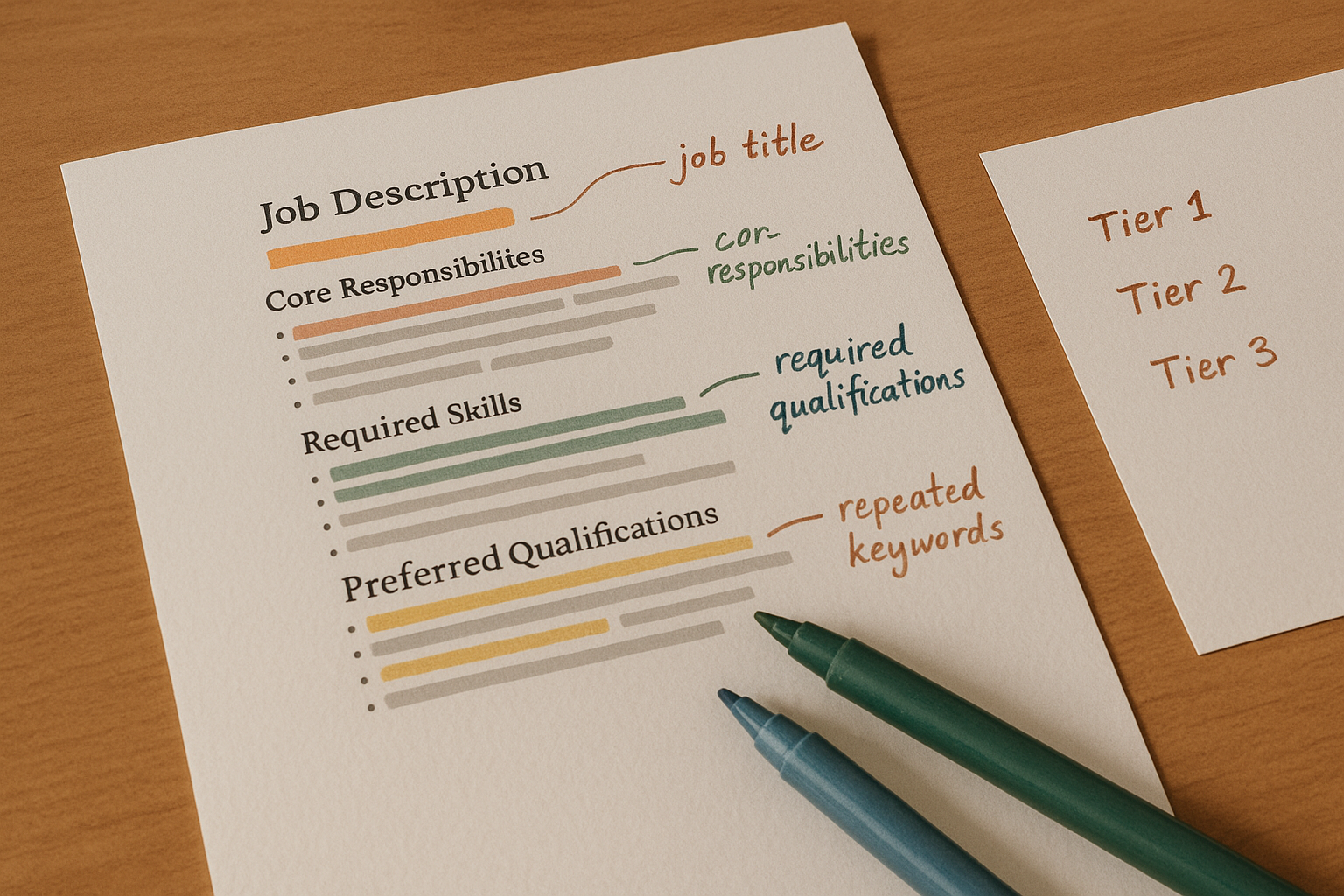 Break the posting into priority signals before you edit your resume.
Job descriptions usually tell you what matters most through repetition and placement. Start there.
Pull out the high-signal elements
Read the posting once without editing your resume. Then highlight five categories:
Job title and level
Look for title variants and seniority cues. “Marketing Analyst” and “Growth Analyst” can overlap, but one may emphasize attribution while the other emphasizes experimentation.Core responsibilities
These are the day-to-day tasks. Count repeated themes. If “build dashboards,” “analyze trends,” and “present insights” appear multiple times, those belong near the top of your experience section.Required skills
Separate technical skills from functional ones. “Python” and “Salesforce” are different from “stakeholder communication” and “program management.”Preferred qualifications
These matter, but they rank below required items. Use them to differentiate if you already meet the core requirements.Repeated keywords and phrases
Pay attention to exact wording. If the posting uses “customer retention” three times, writing only “customer loyalty” may weaken the match unless both terms fit naturally.
Rank what matters
Treat the posting like a weighted list. A simple model works:
- Tier 1: title, top 3–5 responsibilities, required hard skills
- Tier 2: preferred skills, domain knowledge, relevant certifications
- Tier 3: softer traits and generic phrases
This step is critical if you want to tailor resume to job description free using your own process. Without a ranking system, you end up editing random lines instead of the lines that move the match rate.
Step 2: Match your most relevant experience to the role
 Start with a master resume, then pull only the most relevant wins for the role.
Now map your background to the posting. The goal is selection, not expansion.
Open your master resume and pull the items that best support the target role. Focus on evidence tied to the employer’s needs: similar responsibilities, similar tools, similar scope, similar outcomes.
Choose proof, not background noise
For each target requirement, ask:
- Have I done this exact task?
- Have I done a close equivalent?
- Do I have a measurable result tied to it?
- Is it recent enough to matter?
Suppose the role asks for campaign reporting, A/B testing, and stakeholder presentations. A stronger set of bullets would emphasize weekly dashboard reporting, test analysis, and executive readouts. A weaker set would keep old bullets about event support or unrelated administrative work.
Deprioritize content that dilutes fit
Most resumes carry 20–40% irrelevant material for a given job. Cut or shrink it:
- Old roles with little connection to the target
- Bullets that describe routine duties without outcomes
- Skills that do not matter for this posting
- College details that are no longer relevant for mid-career applicants
This is where many candidates fail. They add a few keywords but leave unrelated bullets in place, which lowers clarity. A tailored resume should feel narrower, not longer.
Step 3: Rewrite your summary and bullets for relevance
Once you know what to emphasize, edit the top third of the resume first. That is where recruiters often spend most of their initial scan.
Update the headline and summary
Your headline should mirror the target function if accurate. If you have been “Operations Coordinator” but are applying to “Project Coordinator” roles with overlapping work, your summary can bridge that gap by naming project planning, cross-functional coordination, and reporting.
Keep the summary short. Two to three lines is enough. Include:
- target function or role family
- years of relevant experience
- 2–3 role-specific skills
- one quantified strength or domain area
Example structure:
Data analyst with 3 years of experience in SQL, dashboard reporting, and forecasting for SaaS teams. Built weekly KPI reporting used by marketing and finance, reducing manual reporting time by 30%.
Rewrite bullets to match the role language
Your bullets should start with actions and end with outcomes. More important, they should align with the posting’s priorities.
Weak bullet:
- Responsible for monthly reports and supporting leadership requests
Stronger bullet:
- Built monthly Tableau reports for sales and finance leaders, reducing ad hoc analysis requests by 25% and improving forecast visibility
Notice the differences: named artifact, named audience, named tool, measured result.
If you are searching how to tailor my resume to a specific job using ChatGPT, this is the stage where AI can help generate drafts. Give it the job description, your original bullet, and a clear instruction to preserve truth while increasing relevance. Then edit the output yourself. Accuracy matters more than polish.
Step 4: Add the right keywords without sounding unnatural
Keyword alignment matters because ATS systems rely on text matching. Keyword stuffing fails because recruiters still read the document.
Use this rule: every keyword should live in a credible place.
Where keywords belong
Add role-specific terms in these sections:
- Headline or summary: one or two core terms
- Skills section: tools, platforms, methods, certifications
- Experience bullets: responsibilities and outcomes
- Projects section: especially for early-career applicants
For example, if the posting mentions “CRM,” “pipeline reporting,” and “Salesforce,” place those terms where you actually used them. Do not paste a string of software names into the bottom of the page.
Use close variants carefully
ATS systems vary. Some recognize related terms; some do not. If both are accurate, include both the spelled-out term and the acronym once, such as “search engine optimization (SEO)” or “applicant tracking system (ATS).”
This is also where a tailor resume to job description prompt can help. A useful prompt asks an AI tool to:
- extract required skills and repeated keywords
- compare those to your current resume
- suggest where to add missing terms
- avoid inventing experience
- keep bullets specific and measurable
Candidates often look for tailor resume AI or tailor resume to job description AI free because it saves time. That works best when AI is used for comparison and drafting, then checked by you for accuracy and tone.
Step 5: Check formatting and ATS compatibility
Formatting errors can weaken parsing before a human ever sees the file. Keep the structure conventional.
Use standard section headings like Summary, Experience, Skills, Education. Stick to a single-column layout. Avoid text boxes, icons, tables, headers packed with critical information, and unusual fonts.
File choice matters too. If the application asks for PDF, send PDF. If the employer recommends .docx for ATS parsing, follow that instruction. Name the file clearly: FirstName_LastName_TargetRole_Resume.
A quick ATS compatibility checklist:
- standard headings
- reverse-chronological experience
- dates in a readable format
- consistent bullet style
- no graphics that contain key text
- no copied job-description block pasted into white text
- contact information in the main body, not only in the header
These fixes are small, but small parsing issues can cost you a match.
Step 6: Score your resume against the job before you apply
Do not submit based on feel. Score the resume against the posting first.
A simple fit score can use five categories worth 20 points each:
Title alignment
Does your summary and recent experience support the target role?Core responsibility match
Do your top bullets reflect the job’s main tasks?Required skills match
Are the must-have tools and methods present where relevant?Keyword coverage
Are the repeated terms represented naturally across the resume?Evidence quality
Do bullets show outcomes, scope, and numbers?
A score above 80 usually means strong alignment. A score between 60 and 79 often means there are fixable gaps. Anything lower usually needs another pass or may indicate the role is simply not a fit.
Fit scoring also helps you prioritize applications. If two roles look similar but one scores 84 and the other 62, apply to the 84 first. That is a better use of limited time.
Common mistakes that weaken tailored resumes
The biggest mistake is copying the job description into your resume. ATS may register the words, but a recruiter will spot it quickly. Another common error is editing every line. That creates noise. Change the sections that drive relevance: headline, summary, top skills, and the most recent bullets.
Inflating experience is riskier than many candidates assume. Interviews expose it fast. A better move is to show adjacent experience clearly. “Supported quarterly forecasting for a 6-person finance team” is credible. “Led enterprise forecasting strategy” is not, unless you did.
Irrelevant bullets are another drag on performance. If a bullet does not help prove fit for this role, cut it or move it down. Keywords without evidence cause similar problems. Listing “project management” means little if none of your bullets show timelines, coordination, or delivery.
A final mistake: skipping the fit check. Tailoring without measurement turns into busywork.
How Stellar helps
Stellar makes this process faster and more consistent. You can tailor a resume to a job posting, check resume-to-job fit before applying, and keep your applications organized in one workflow. That gives you a clearer view of which roles match your background and where your next edit should go.
A tailored resume does not require a full rewrite. It requires a master resume, a structured read of the job description, focused edits, and a fit score before submission. If you want a faster system for doing that across multiple applications, Stellar is built for exactly that.